Which Activities Will Not Help With Lead Generation: Avoid These Common Mistakes
Lead generation remains the lifeblood of business growth in 2026. Every marketing team wants to fill its pipeline with qualified prospects who are ready to convert. But here’s the uncomfortable truth: not every activity labeled as “lead generation” actually generates leads.
After working with hundreds of businesses and analyzing what separates successful campaigns from failed ones, I’ve identified the activities that consistently waste time, budget, and resources while delivering minimal results. Understanding which activities will not help with lead generation is just as important as knowing what works.
Let’s explore the tactics you should avoid if you want real results from your marketing efforts.
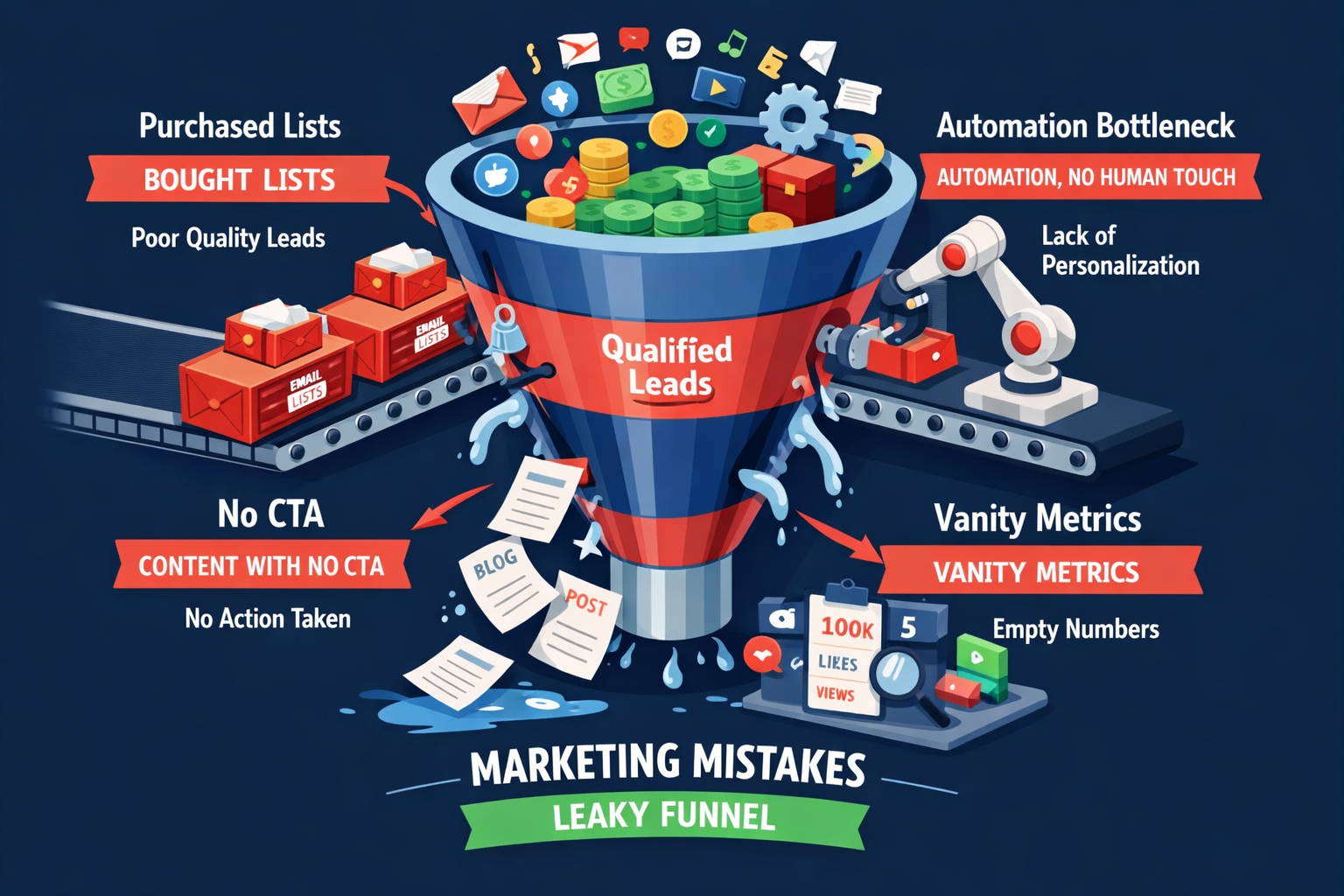
1. Buying Email Lists and Cold Contacts
One of the biggest myths in lead generation is that you can buy your way to a full pipeline. Purchasing email lists might seem like a shortcut to thousands of potential customers, but this approach fails on multiple levels.
When you buy contact lists, you’re reaching out to people who never expressed interest in your business. These individuals haven’t opted in to hear from you, which means your emails land in spam folders or get immediately deleted. The engagement rates on purchased lists hover around 0.5% or less, far below the industry average of 2-3% for organic lists.
Beyond poor performance, purchased lists carry serious risks. Anti-spam regulations like GDPR and CAN-SPAM impose heavy fines on businesses that email people without consent. One complaint can damage your sender reputation, causing even your legitimate emails to be filtered as spam.
Real lead generation builds relationships with people who genuinely want to hear from you. Focus on growing your list organically through valuable content, webinars, and opt-in forms rather than taking shortcuts that damage your brand.
Also Read: All Tips
2. Creating Content Without Strategic Intent
Content creation has become synonymous with lead generation, but simply publishing blog posts doesn’t automatically generate leads. Too many businesses fall into the trap of creating content for content’s sake, without any clear strategy connecting their articles to conversion goals.
Writing generic blog posts about your industry without addressing specific pain points your audience faces won’t move the needle. Your content needs to solve real problems, answer burning questions, and guide readers toward a logical next step that involves your product or service.
Content that doesn’t help with lead generation includes:
- Articles with no clear call-to-action
- Blog posts targeting irrelevant keywords with no commercial intent
- Content that doesn’t align with your buyer’s journey
- Posts that fail to establish your expertise or authority
The fix involves mapping your content to different stages of the customer journey. Awareness-stage content should educate and attract, consideration-stage content should compare and evaluate, and decision-stage content should convert. Each piece needs a purpose beyond simply existing on your website.
Also Read: Making Money Tips
3. Social Media Activity Without Engagement Strategy
Posting randomly on social media platforms might keep your profiles active, but it won’t generate qualified leads. Many businesses mistake social media presence for social media strategy, spending hours creating posts that receive a handful of likes but zero conversions.
Activities that waste time on social media include posting motivational quotes without context, sharing content from other brands with no original perspective, and broadcasting promotional messages without engaging in conversations. These tactics might maintain visibility, but they don’t build the relationships that lead to business opportunities.
Lead generation on social media requires genuine engagement. You need to participate in industry discussions, respond thoughtfully to comments, share insights based on your experience, and build authentic connections with potential customers. Simply scheduling posts through automation tools without monitoring responses or joining conversations leaves opportunities on the table.
The platforms where your audience actually spends time matter more than being present everywhere. A focused strategy on two platforms with active engagement beats scattered presence across six platforms with minimal interaction.
Also Read: Investment Tips
4. Attending Networking Events Without Follow-Up Systems
Networking events and trade shows offer valuable face-to-face opportunities, but attendance alone doesn’t generate leads. Collecting a stack of business cards and then letting them sit in your desk drawer represents wasted investment and missed opportunities.
The real work begins after the event ends. Without a systematic follow-up process, those connections go cold within days. Your new contacts meet dozens of people at the same event, and without prompt, personalized follow-up, they’ll forget your conversation entirely.
Ineffective networking includes attending events in industries unrelated to your target market, failing to qualify contacts during conversations, and treating every person you meet as a potential customer rather than building genuine professional relationships. Not every connection will become a lead, and that’s perfectly fine.
Successful lead generation from events requires pre-event preparation, strategic conversations during the event, and disciplined follow-up within 48 hours. You need a system for capturing contact information, notes about conversations, and next steps that integrate with your CRM.
5. SEO Focused Only on High-Volume Keywords
Search engine optimization plays a crucial role in lead generation, but chasing high-volume keywords without considering search intent wastes resources. Ranking for terms that attract millions of visitors means nothing if those visitors aren’t potential customers.
Keywords with massive search volume often indicate informational queries from people in early research stages who aren’t ready to buy. For example, ranking first for “what is marketing” might drive traffic, but those visitors are seeking definitions, not marketing services.
Lead generation requires targeting keywords that indicate commercial intent. People searching for comparisons, reviews, pricing, and specific solutions are closer to making decisions. A keyword with 500 monthly searches but high purchase intent generates more qualified leads than a keyword with 50,000 searches from casual browsers.
Focus your SEO efforts on understanding the questions your ideal customers ask when they’re ready to solve their problems. Long-tail keywords and question-based queries often convert better than broad, competitive terms.
6. Neglecting Data Quality and List Hygiene
Building a large contact database feels productive, but if that database contains outdated information, invalid email addresses, and unengaged contacts, it actively harms your lead generation efforts. Many businesses focus exclusively on list growth while ignoring list quality.
Maintaining contacts who haven’t engaged with your content in years dilutes your metrics and damages your sender reputation. Email service providers track engagement rates, and consistently sending to unengaged contacts signals that your emails aren’t valuable, reducing deliverability even for interested subscribers.
Activities that waste resources on bad data include never removing bounced email addresses, keeping contacts who haven’t opened emails in over a year, and failing to update contact information as people change jobs or companies. This digital clutter makes it harder to identify and nurture actual opportunities.
Implement regular list cleaning processes that remove inactive contacts, verify email addresses, and segment your database based on engagement levels. A smaller list of engaged prospects generates more leads than a massive list of disinterested contacts.
7. Automating Everything Without Personal Touch
Marketing automation tools offer incredible efficiency, but over-automation creates robotic experiences that repel potential customers rather than attract them. When every interaction feels scripted and impersonal, you lose the human connection that builds trust and drives conversions.
Sending the same generic drip campaign to every new contact, regardless of how they found you or what they’re interested in, wastes the personalization capabilities of modern marketing tools. Automation should enhance human interaction, not replace it entirely.
Lead generation suffers when you automate without strategy:
- Generic automated responses that don’t address specific inquiries
- Drip campaigns that continue even after a prospect has converted
- Social media posts scheduled without monitoring responses
- Chatbots that can’t escalate to human support when needed
The most effective approach combines automation for efficiency with human touchpoints for relationship building. Use automation to handle repetitive tasks, segment your audience, and trigger timely follow-ups, but ensure that genuine human interaction occurs at critical decision points.
8. Ignoring Existing Customers for New Prospects
Many businesses obsess over acquiring new leads while neglecting their most valuable asset: existing customers. This tunnel vision on new acquisition misses massive opportunities for referrals, upsells, and testimonials that generate higher-quality leads than cold outreach.
Your current customers already trust your business, understand your value, and can speak authentically about their experiences. They’re your best source of warm introductions to similar prospects, yet many companies fail to create structured referral programs or make it easy for satisfied customers to share their experiences.
Activities that ignore this goldmine include never asking for referrals, failing to nurture customer relationships after the sale, and treating customer success as separate from marketing and sales. When you focus exclusively on filling the top of your funnel, you miss opportunities to leverage the bottom.
Build systems that encourage customer advocacy. Create referral programs with clear incentives, make it simple for customers to leave reviews and testimonials, and maintain regular communication that keeps your business top-of-mind when they hear about someone with a relevant need.
9. Participating in Every Marketing Trend
The marketing landscape constantly evolves with new platforms, tactics, and trends. While staying current matters, jumping on every bandwagon dilutes your efforts and prevents you from mastering strategies that actually work for your business.
When a new social media platform launches or a novel tactic gains attention, many businesses rush to participate without considering whether their target audience is actually there. This scattered approach spreads resources thin and prevents deep expertise in any single channel.
Lead generation requires focus and consistency. Better results come from mastering two or three channels that align with your audience than dabbling in ten different tactics. Building expertise and refining your approach over time compounds results, while constantly switching strategies resets your progress to zero.
Evaluate new opportunities through the lens of your specific business goals and audience behavior. Ask whether your ideal customers use this new platform, whether you have the resources to execute well, and whether it aligns with your overall strategy before investing time and budget.
10. Measuring Vanity Metrics Instead of Real Results
The final activity that doesn’t help with lead generation involves tracking metrics that feel good but don’t drive business outcomes. Many teams celebrate increased website traffic, social media followers, and email open rates while ignoring the metrics that actually matter: qualified leads, conversion rates, and revenue generated.
Vanity metrics create the illusion of progress without demonstrating business impact. A million social media impressions mean nothing if they don’t result in conversations with potential customers. High email open rates don’t matter if nobody clicks through or takes action.
Focus your measurement on metrics that connect directly to business results:
- Number of marketing qualified leads generated
- Conversion rates at each stage of your funnel
- Cost per acquisition for different channels
- Revenue attributed to specific campaigns
- Customer lifetime value by lead source
Understanding which activities will not help with lead generation requires honest assessment of what actually drives results versus what simply keeps you busy. The activities that waste resources share common characteristics: they prioritize quantity over quality, automation over authenticity, and activity over strategy.
Building a Lead Generation Strategy That Works
Now that we’ve identified what doesn’t work, let’s briefly discuss what does. Effective lead generation focuses on understanding your ideal customer deeply, creating valuable content that addresses their specific needs, building genuine relationships through consistent engagement, and optimizing based on data that matters.
Your strategy should align every activity with clear business objectives. Before launching any campaign or tactic, ask yourself: “Will this attract qualified prospects who are likely to become customers?” If you can’t confidently answer yes, reconsider whether it deserves your resources.
The businesses that excel at lead generation don’t chase every opportunity or follow every trend. They develop deep expertise in strategies that work for their specific audience, measure what matters, and continuously refine their approach based on real results.
Conclusion
Understanding which activities will not help with lead generation saves you from wasting precious time and budget on tactics that look productive but deliver minimal results. Buying contact lists, creating content without strategy, posting on social media without engagement, attending events without follow-up, chasing high-volume keywords without intent, neglecting data quality, over-automating, ignoring existing customers, jumping on every trend, and measuring vanity metrics all distract from real lead generation work.
The path to consistent lead generation involves focusing on quality over quantity, building authentic relationships, delivering genuine value, and measuring what actually drives business results. By avoiding these common pitfalls and concentrating your efforts on proven strategies aligned with your specific audience, you’ll generate more qualified leads with less wasted effort.
Remember that effective lead generation is a marathon, not a sprint. The shortcuts that promise quick results rarely deliver sustainable growth. Invest in building a solid foundation based on understanding your customers, creating valuable content, and nurturing relationships, and you’ll see consistent results that compound over time.